A team of scientists from the Faculty of Biology at the University of Gdańsk, led by Prof. Anna Herman-Antosiewicz, has obtained two patents for innovative inventions—two organic compounds, derivatives of usnic acid—intended for use in cancer treatment.
– The portfolio of inventions created at the Faculty of Biology of the University of Gdańsk has been expanded with two more patents,- says Katarzyna Gronowska, director of the Technology Transfer Center, which coordinates the process of protecting the intellectual property of the research results of scientists at the University of Gdańsk. – The granting of a patent by the Polish Patent Office is official confirmation of the innovative nature of the inventions. It ensures their legal protection in Poland.
The innovations were developed by a team led by Prof. Anna Herman-Antosiewicz, which included Mariola Gimła, MA, Klaudia Żuczek, MA, Maciej Brodecki, MA (then still a second-cycle student), Dr. Anna Pawlik, and Dr. Tristan Reekie from the School of Science, University of New South Wales Canberra in Australia.
Fot. Alan Stocki
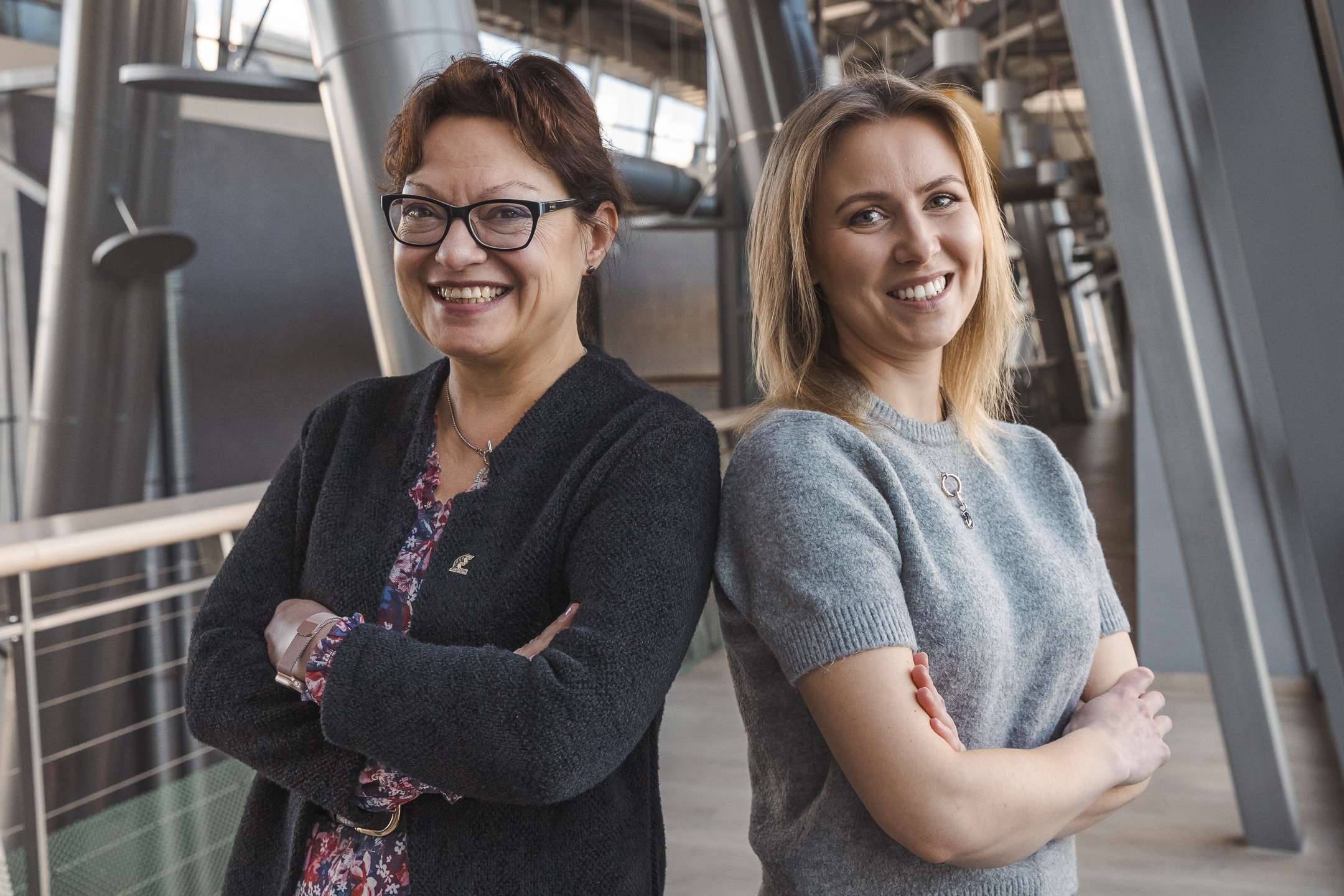

Na zdjęciach od lewej: prof. dr hab. Anna Herman-Antosiewicz i doktorantka Klaudia Żuczek; doktorantka Mariola Gimła
– Usnic acid is a well-known biologically active compound isolated from lichens. It exhibits a broad spectrum of activity, including antiviral, antifungal, antibacterial, immunomodulatory, and anti-inflammatory properties. It is also known for its cytotoxic activity against cancer cells, but it must be used in high concentrations, which unfortunately are also toxic to normal cells.
– New usnic acid derivatives have much stronger cytotoxic properties than usnic acid itself in relation to cancer cells, including those of the pancreas, cervix, and breast, while normal cells are less sensitive to them,- says its creator, Prof. Anna Herman-Antosiewicz. – Even relatively low concentrations of the derivatives inhibit the ability of cancer cells to migrate, cause characteristic changes in cancer cells resembling holes (known as vacuolization), and ultimately cause the death of these cells.
Modifications introduced to the known structure of usnic acid resulted in greater selectivity and cytotoxicity in their effect on cancer cells. For this reason, the new compounds may be used as therapeutic agents in cancer treatment. Since they cause a specific type of cancer cell death associated with vacuolization, they can also be used as inducers of this type of process in basic research.
–These inventions open up new possibilities for the development of a drug for cancer, including pancreatic cancer, which is extremely difficult to treat due to the usually advanced stage of the disease at the time of diagnosis, as well as the characteristics of the tumors themselves, including the resistance of cancer cells to therapy and the limited penetration of drugs into tumor tissue. This important achievement highlights the University of Gdańsk’s commitment to research and development of future technologies, emphasizes Prof. Herman-Antosiewicz.
– Usnic acid, a metabolite produced by lichens, has a number of interesting activities, including the inhibition of tumor growth. Unfortunately, for this purpose, it must be used in high concentrations, which are also toxic to normal cells in the body, especially liver cells. The aim of our team’s work was to modify the structure of this compound to obtain derivatives that would be more selective and toxic to cancer cells than to healthy cells, says the professor. “We have obtained acid derivatives that not only cause the death of pancreatic, cervical, and breast cancer cells at lower concentrations than the parent compound, but also inhibit their ability to move, a feature that enables cancer cells to metastasize. In addition, the death of cancer cells is accompanied by a specific type of stress (known as endoplasmic reticulum stress), which manifests itself in the appearance of large vacuoles in these cells that look like holes. It is also known that such stress is generally higher in cancer cells than in healthy cells, especially in pancreatic cells, so its slight increase by our derivatives has a lethal effect on cancer cells. These compounds can also be used in basic research to induce this type of stress in cells in order to study its role and consequences.
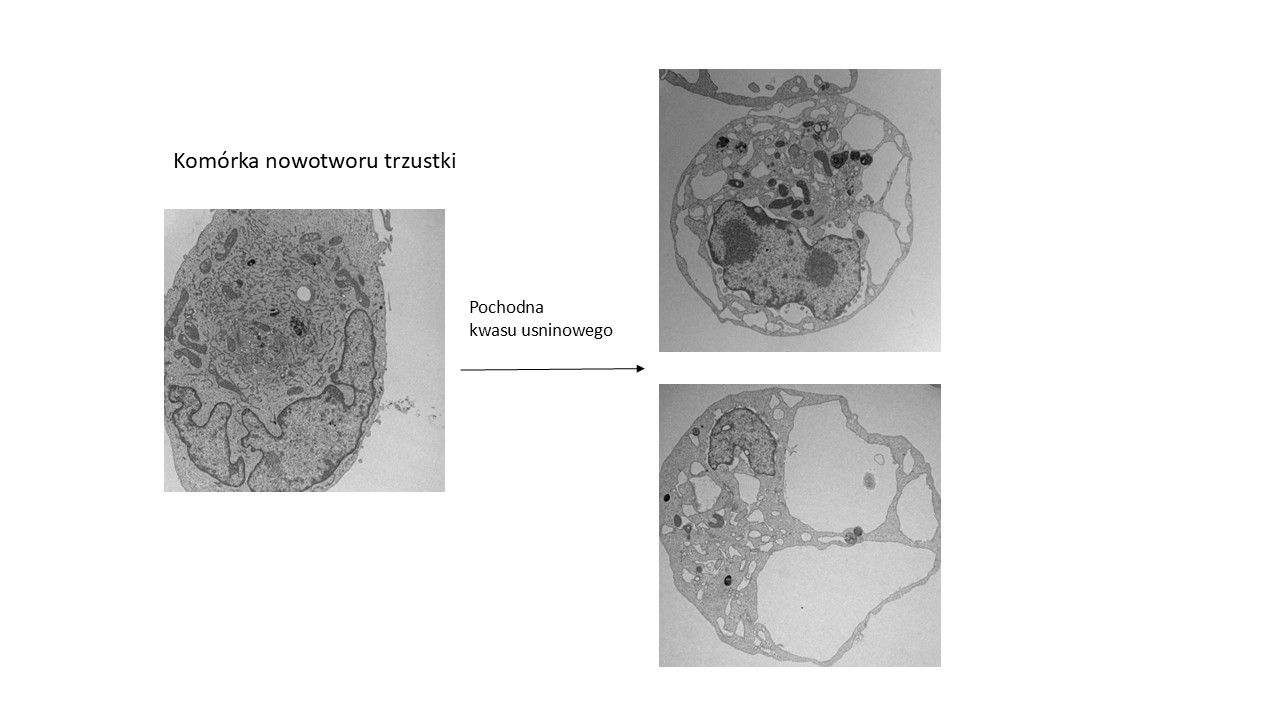
Zdj.: dr hab. Magdalena Narajczyk, Wydział Biologii UG
What opportunities does the patent open up? The invention enables further research, including improving the method of administering the drug and identifying the characteristics of cancer cells that make them particularly sensitive to the drug, thus attempting to personalize its use.
– Work on usnic acid derivatives with anticancer properties began in 2016, when a team of chemists from Australia sent a colleague researching lichens (Dr. Beata Guzow-Krzemińska) the first compounds to test their… antibacterial activity,” says Prof. Herman-Antosiewicz. “It turned out that as a result of modifying the structure of usnic acid, it loses its antibacterial activity, but gains cytotoxic activity against cancer cells. Further, more targeted changes and their biological effect were studied during the Harmonia grant from the National Science Centre in collaboration with a team of chemists from Australia. This resulted in several publications and patents, but above all in knowledge about which elements of the usnic acid structure are important for the anti-cancer activity of its derivatives, how they can be improved, and what their mechanisms of action are. What is more, two of the derivatives have been tested in vivo on a mouse model with transplanted human breast or pancreatic cancer cells, and the results obtained are very promising.
The invention has great potential for use in the treatment of various types of cancer, especially pancreatic cancer, which has the lowest cure rate (5-year survival rate from diagnosis is approximately 9% of patients). This is because it is usually diagnosed at an advanced stage, surgical removal of the tumor is possible for only a small group of patients, and these tumors are highly resistant to chemotherapy drugs. Hence, there is a need to search for more effective drugs, and nature is an inexhaustible source of them. Experimental data show that our derivatives act on various cancer cells and the environment in which they live in the tumor. We also know what their target is in cancer cells and why they are selective towards them.
The creator intends to continue research with her team in order to obtain formulations of usnic acid derivatives that will be even more effective in reaching tumor tissue and their target in cancer cells (Opus project submitted to the National Science Centre in cooperation with the Medical University of Gdańsk and with the participation of specialists from the Faculty of Chemistry of the University of Gdańsk and from Australia).
Thanks to patent protection, the University of Gdańsk has the opportunity to further develop and commercialize the invention in medicine.
Contact: Technology Transfer Office – +48 58 523 33 74 lub +48 58 523 33 75, biuro@ctt.ug.edu.pl