V4 for Innovation: Knowledge Transfer Cooperation of V4 Countries
The unique “Commercialisation and Spin-off Support” event, which took place on 14 May 2026 at the University of Gdańsk, was a practical workshop aimed at researchers, students, entrepreneurs and investors. The main focus of the event was on methods for assessing the technological and business maturity of innovations, as well as the forms of support available to spin-off companies.
About the workshop
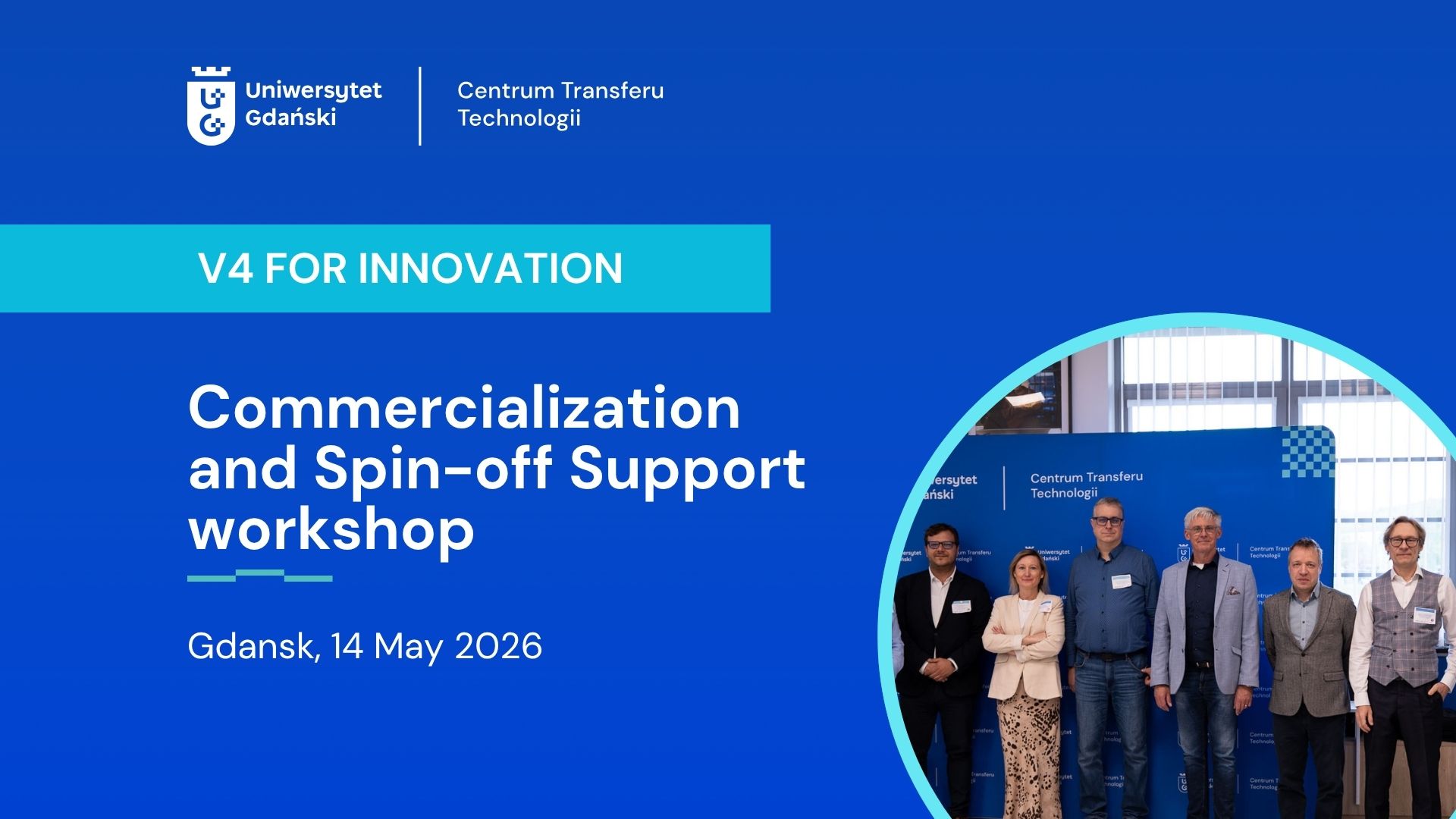
On 14 May, at the University of Gdańsk’s Main Library, the University’s Technology Transfer Centre became the hub of a regional dialogue between the academic community and the business sector. We hosted 40 participants at the international workshop ‘Support for Commercialisation and the Creation of Spin-off Companies’, organised as part of the V4 for Innovation project.
International Knowledge Transfer at the Uniwersytet Gdański
Last Thursday (May 14), Centrum Transferu Technologii UG became a hub for regional dialogue between academia and business. We hosted 40 participants in the international workshop “Commercialization and Spin-off Support” organized as part of the “V4 for Innovation” project.
The presentation by Marcin Pawłowski, Associate Professor at the ICTQT – International Centre for Theory of Quantum Technologies at the University of Gdańsk, was met with great interest from the audience. In his lecture “Hard Science, Harder Markets: Deep Tech Lessons from the Frontier,” he shared his own experiences with the commercialization process of a quantum random number generator.
The professor highlighted the various challenges, and even pitfalls, that an inventor may encounter during the technology development phase and the creation of a Proof of Concept (PoC).
Researchers and students from nine units of the University of Gdańsk ( Faculty of Chemistry, Intercollegiate Faculty of Biotechnology UG & MUG UG & MUG, International Centre for Cancer Vaccine Science, University of Gdansk, Wydział Prawa i Administracji, UG, Wydział Matematyki, Fizyki i Informatyki, Uniwersytet Gdański, Faculties of Economics, Management, and Social Science).
The local government and business communities were represented by Justyna Szybska-Lewandowska and Sylwia Bryłała from the Pomorskie Voivodeship
🇸🇪 The workshop program centered on the Swedish KTH Innovation Readiness Level™ methodology, specifically its three pillars: Business, Product, and Resource Management. The practical session was preceded by an introduction by Jarek Chojecki, who provided an overview of KTH and – during the group work phase – served as a facilitator to support the working teams.
Participants also had the chance to connect with international experts involved in the “V4 for Innovation: Knowledge Transfer Cooperation of V4 Countries” project.
Therefore, we would also like to extend our sincere thanks for their substantive contributions to Bulcsu Gödri (Director of Business Development at the Technology Transfer Company of the University of Szeged), Dušan Rostáš, PhD (Director of the Technology Transfer Center at Pavol Jozef Šafárik University in Košice), and Josef Sláma (Entrepreneurship Development Coordinator at Brno University of Technology).
SZTE TTC z Węgier, zajmuje się transferem technologii przy Uniwersytecie w Szegedzie, lider projektu.
Brno University of Technology z Czech – wiodąca uczelnia techniczna posiadająca bogate doświadczenie w zakresie wsparcia projektów, transferu wiedzy i technologii oraz współpracy między uczelnią a przemysłem.
University of Gdańsk – Technology Transfer Office, wspierająca zarządzanie własnością intelektualną w uniwersytecie Gdańskim. wdrażanie wyników badań naukowych na rynku.
Pavol Jozef Šafárik University in Košice – Technology and Innovation Park ze Słowacji, zapewniający naukowcom wsparcie w zakresie transferu technologii, ułatwiając współpracę między podmiotami ze środowisk akademickich i przemysłowych.
Homepage | International Visegrad Fund