

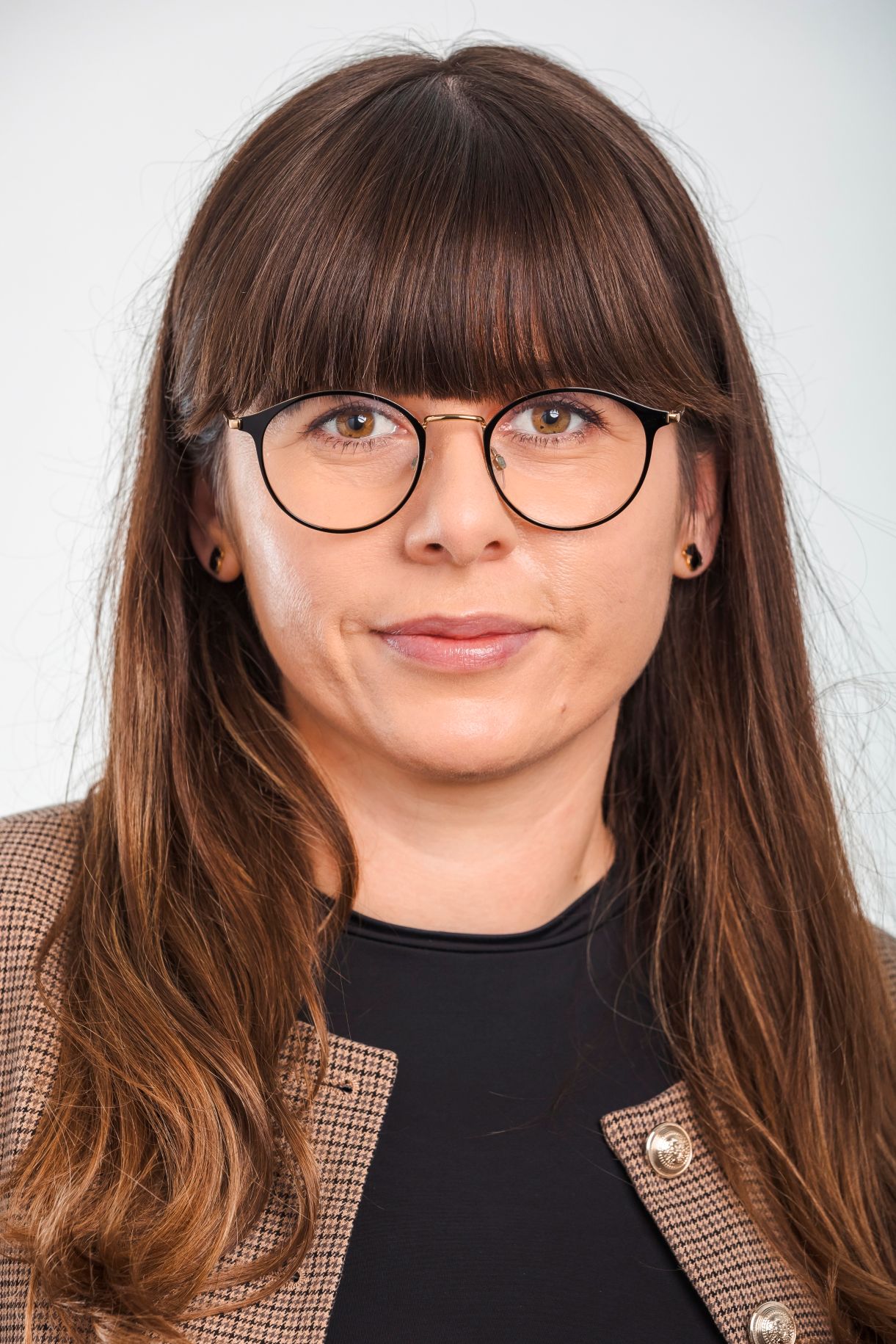
Dr. Aneta Lewkowicz’s invention concerning an innovative method of visualizing fingerprint traces has been granted protection by the Patent Office of the Republic of Poland.
The search for new methods of visualizing fingerprint traces and less toxic solutions using 1,8-diazafluorene-9-one (DFO) is particularly important in the development of forensics.
Traditional methods of examining fingerprints using DFO on absorbent/porous surfaces rely on toxic solvents that are not suitable for revealing them on thermal paper. The detection of dactyloscopic traces from these surfaces can be difficult because the components of the developing solution react with the components of thermal paper.
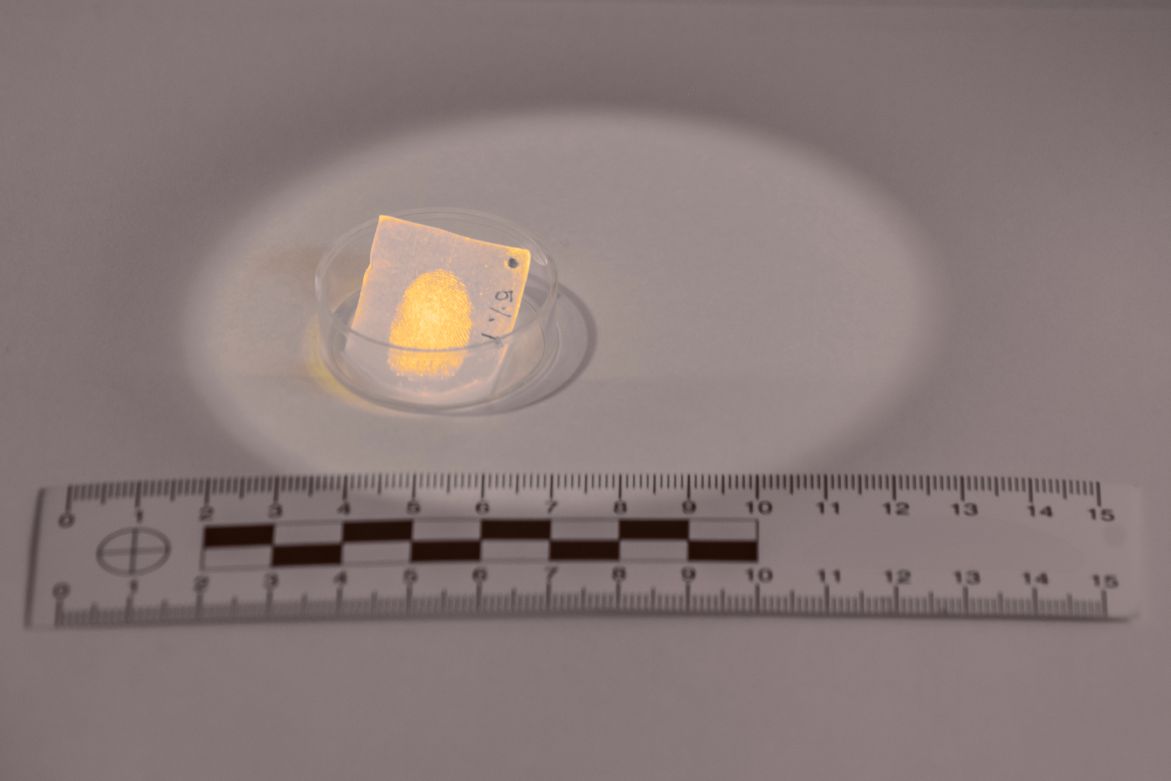
The new method of visualizing fingerprint impressions from highly absorbent surfaces such as plain paper or thermal paper may represent a breakthrough in fingerprinting.
– The method I have developed differs from those previously used with DFO because it allows fingerprint impressions to be revealed on thermal paper,” says Dr. Aneta Lewkowicz. The intensive development of communication tools, especially in electronic form, has not ruled out the recording of government documents, for example, on thermal paper. What is more, in everyday use, we deal with receipts that are printed on this specific type of paper. Any image on thermal paper, including fingerprints, can be very unstable, especially when revealed. The greatest risk is the darkening/blackening of the entire surface of the paper when using solutions to visualize dactyloscopic traces,” explains Dr. Lewkowicz. The procedure I developed made it possible to avoid this phenomenon and, in addition, significantly reduced the toxicity of the solutions used, which made it possible to go outside the laboratory, i.e., it became useful at the scene of the incident.
Phot. Alan Stocki. CKiP UG
Effective visualization of fingerprint prints was possible thanks to the characterization of the spectroscopic properties of DFO. For the first time, attention was drawn to the great importance of aggregation processes in the creation of new spectroscopically active forms useful in the detection of forensic traces, with particular emphasis on fingerprint prints. Research in the field of time-resolved methods confirmed that during the visualization of dactyloscopic traces, it was the stable DFO dimer obtained as a result of optimizing aggregation processes that led to the enhancement of the visualization process of dactyloscopic traces on thermal paper. Once again, I would like to draw attention to the enormous power of the skilful application of molecular physics with parallel awareness of the chemical processes dependent on the concentration of the molecule under study,” emphasises the researcher. The presented result represents progress in the field of obtaining new fluorescently active structures without the need for complex organic syntheses, often involving the use of toxic co-reagents. New doors are opening for the perception of chemical processes using physical phenomena at the molecular level on a very small time scale, thanks to which we can visualize various types of forensic evidence.
– How will this affect the detection of crimes/criminals? First and foremost, the invention increases the possibility of revealing dactyloscopic traces at the scene of the crime, on so-called difficult surfaces. Until now, working with these surfaces was only possible in a laboratory due to the toxic components of the developing solution and the low stability of the solution’s components in relation to the components of thermal paper. Therefore, this will significantly affect the acquisition of fingerprints that have been left on difficult surfaces, says Dr. Aneta Lewkowicz.
The solution can be used by forensic technicians and fingerprint experts in forensic laboratories.
– I have been interested in fingerprinting since the beginning of my scientific career – says the inventor. “I graduated from Jagiellonian University with a degree in chemistry, specializing in forensic chemistry, and I completed my experimental master’s thesis at the Jan Sehn Institute of Forensic Research in Krakow. In addition, a joint scientific project between the National Science Centre Opus and the Faculty of Law and Administration at the University of Gdańsk (WPiA), carried out in the field of fingerprinting, allowed me to conduct research that has been recognized with numerous publications, awards from the Polish Society of Forensic Science, and, very importantly, a patent. The excellent cooperation with the Faculty of Law and Administration, both at the teaching and research levels, and the establishment of the Forensic Evidence Disclosure Laboratory at WPiA were made possible thanks to the support of: the Dean of WPiA, Prof. Wojciech Zalewski, and the then Dean of the Faculty of Mathematics, Physics and Computer Science (WMFiI) at the University of Gdańsk, the head of the Department of Biomaterials and Medical Physics, Prof. Piotr Bojarski, as well as the head of the Department of Criminal Procedure and Forensic Science, Prof. Sławomir Steinborn, and the head of the Department of Forensic Science and Evidence Law, Prof. Krzysztof Woźniewski.
Dr. Wojciech Zalewski, professor at the University of Gdańsk and Dean of the Faculty of Law and Administration, comments on obtaining the patent:
–-We are proud that Dr. Aneta Lewkowicz’s invention, which is important for criminalistics, was developed within the organizational framework of the Faculty of Law and Administration at the University of Gdańsk. This is a unique situation in which this type of work is undertaken at the Faculty of Law. We are proud that the development strategy we have been building over the years is bearing such fruit.
In turn, the Director of the Institute of Experimental Physics, head of the Department of Biomaterials and Medical Physics at the University of Gdańsk, Prof. Piotr Bojarski, comments on the results of the inventor’s research work:
-I am glad that Dr. Aneta Lewkowicz, my former doctoral student and currently an employee of the Department of Biomaterials and Medical Physics, which I have the privilege of heading, has successfully applied the knowledge and research tools from our scientific interests to the development of a separate scientific specialty, namely forensics. Her thoughtful actions, supported by good interdisciplinary cooperation, have led to the creation of a national patent. I hope that this success will translate into commercialization carried out at the University of Gdańsk.
Dr. Krzysztof Czub from the Faculty of Law and Administration at the University of Gdańsk supported the scientist in preparing the patent description. The process of applying for a patent at the Polish Patent Office was coordinated by the Technology Transfer Center at the University of Gdańsk, headed by Katarzyna Gronowska, which also manages the commercialization of inventions at the University of Gdańsk.
Contact: Technology Transfer Office – +48 58 523 33 74 lub +48 58 523 33 75, biuro@ctt.ug.edu.pl


